
Barefoot running has been controversial for quite some time. There has been the rise of barefoot running through books like Born to Run and the fall some time after as the infamous Vibram five fingers, AKA the “toe shoes”, came and went. But what nobody quite expected was for yet another resurgence with companies like Vivobarefoot and Xero shoes building their brands relatively under the radar the past few years. Joe Rogan referenced Vivobarefoot’s trail shoes in one of his podcasts quite some time ago and Xero shoes has also gained some popularity. Most anyone who watches running YouTube is bound to see an ad for these shoes at some point. Vivobarefoot is the more hip and high end of the barefoot spectrum with the Xero Shoes being a much more affordable version. But today isn’t quite about these two companies. Today is about the merit to this resurgence in barefoot running. Is barefoot running really all that great? I’m here to discuss with you some reasons to really think about this interesting tool and the possibility of finding it in your tool bag in the near future.
So keep in mind that I am not re-inventing anything here. It makes perfect sense that at some point in the past (like a loooong time ago) if you wanted to run, it was going to be without shoes on. This is why many who talk about barefoot running as a good thing describe it as being the “natural” thing to do, however, I am not here to discuss that either. I am concerned with whether barefoot running can help with an athlete’s training. I am also concerned with the idea that more cushion is better. I can remember a worker one day explaining to me and a few others that she needed her memory foam. She said that one day we would understand, alluding to the fact that she was older than the kids who could run around in very non-cushioned shoes, such as Vans and Converse, all day long.
In terms of the literature, barefoot running does not necessarily reduce injury [4]. This is also an almost bogus question, as the number of factors that play a role in injury are tremendous. To rely on one factor, that of barefoot or barefoot simulated running, is questionable to say the least. The point that I will try to make is some benefits of this method as one of the many tools competitive and leisurely runners can use for their overall health.
Let us take for example one study done over a 16-week period [2]. In this study, people transitioned slowly into barefoot running, and at the onset, they had higher loading rates in barefoot shoes over conventional shoes. These loading rates are used as a direct correlation between running and stress injuries. What was interesting about the findings though, was that at the end of the 16-week period, the candidates who completed the program had lower loading rates while in barefoot simulating shoes and conventional running shoes. The main drawback of the study was that only 6 participants completed the program, however, the program was over a four month period which gives it some merit as this is a long time to conduct such a controlled experiment.
It would be nice and easy to say that conventional shoes or barefoot shoes are better, but that isn’t the case. The best way to “prevent” injury is to be stronger, and strength requires calculated stress which can then be repaired. The benefit of barefoot running that is shown is the possibility to manage load more effectively. But it is not required that all miles be done barefoot to do so. Over the 16 weeks, the 6 runners only got to the point that they were doing 20% of their total mileage barefoot. So let’s say that you’re running 40 miles a week, you’d only be doing 8 of those miles barefoot/barefoot simulated. My point is that the benefits that this form of running could attribute to load management may be reason to implement it as a tool and that to achieve those benefits, only a small amount of weekly load will be attributed to the method.
In another study [5] that seems to refute some of the evidence presented, some runners actually had a negative response to barefoot running. The sample of this group was larger, but the length of the study was 8 weeks versus the 16 weeks of the previous study mentioned. Take of this what you will, but I wanted to present it as to not romanticize the method of running barefoot.
The next point is more so correlational, but it is regarding the opposite of barefoot shoes, which is the max cushion phenomenon. Not too long ago, marathon runners would run in racing flats. A lightweight, thin-soled shoe, even thinner than the daily trainer like the New Balance 1080 or the Nike Pegasus. But then, the world changed as the Nike Vaporfly was introduced. The days of racing in 15mm stack heights were over as 40mm racing shoes took the running world by storm. Now, it would be more of a surprise if someone won a marathon not wearing some sort of “super-shoe”. When it comes to managing loads, however, thicker running shoes exacerbate the problem of loads. The main problem with the conclusion of the study [3] referenced in terms of this discussion, is that it discussed the amplification of loads in max-cushioned shoes while using a conventional running shoe as the control. In other words, it used a non-barefoot simulating shoe (Brooks Ghost 6) and compared it to a max cushion shoe (Hoka Conquest). Yes, the max-cushion shoe did amplify loads while running, but there was no testing done specifically on barefoot shoes. It is simply a correlational conclusion for me to say that barefoot running would make managing loads more efficient by comparing the two studies directly.
As well as the prospect of reducing or managing loading rates more efficiently, barefoot running can aid in changing the form of a runner [1]. This idea is highly intriguing as running form can greatly assist in overall efficiency. This change of form is mainly because barefoot running can be uncomfortable and so to deal with the discomfort, the body reacts and changes its form.
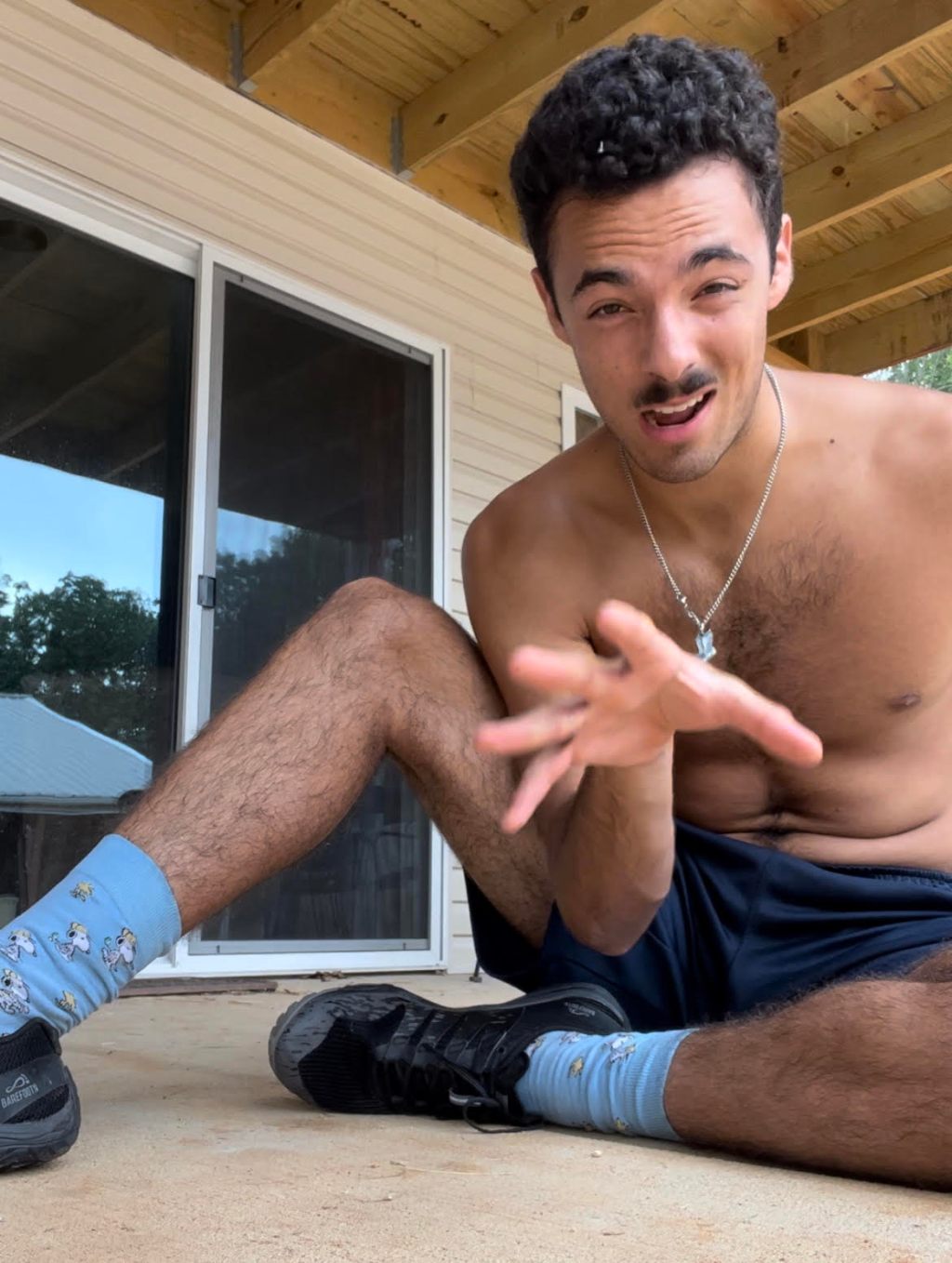
As a piece of anecdotal evidence, I have ran barefoot on a few occasions. During high school, I ran barefoot as a Sophomore and Junior, stopping at the beginning of my Senior cross country season when I got a stress fracture. Yikes, right? Well, sort of. For some context, I went from a week where I ran 48 miles to a week where I ran 71 miles one week over the summer. Also, I would work with my dad over the summer as a workhand, where we would be outside digging ditches and building decks in the summer sun all day. Overall caloric intake, the stress of being a high school kid and assuming the world is on your shoulders, the hopes and pressures of running in college, plus the potential of inadequate training methods through an absurd increase in mileage and barefoot running all contributed to my specific injury. I say this with some optimism as I ran barefoot once again this past summer (summer of 2022) where I did not observe an injury. In fact I began barefoot running as I was concerned that if I didn’t change something I would get injured. I increased mileage all summer wherein my peak week of training, I ran 83 miles. I reference my mileage to show that I stayed healthy while running barefoot simulated for 100% or my miles whereas those who saw benefits in load management only ran 20% of their miles barefoot.
I must add though that I did go back to the modern way of running. The main reason I went back to conventional shoes is because of one thing. My legs were blasted. Again, this is in part due to working with my dad and eating habits that didn’t suit the amount of activity I was doing, but my legs were tired and I needed a fix. I transitioned back into conventional shoes and soon enough my legs felt springy. It isn’t completely one to one but what I did observe for myself is that barefoot running can be done safely, in fact I still enjoy the feeling every now and then. You feel light and springy once you get used to it. My foot mobility is better and my feet are stronger too. It is for those reasons that I will keep this tool in my rotation but not transition to running completely barefoot again.
So for the practical concept, using the evidence we have I would say to maintain a rotation. For the sake of form and strength, in the same way we would change shoes for a workout as the objective is different between it and an easy run, we can do drills, short easy runs, and warmups/downs barefoot. Form can be enhanced and learned, it is not strictly stagnant. On the same note, the grind of the runner is hard and strenuous and some days you just want the legs to feel good. In this case, your average daily trainer may be what you want, so use it. Personally, I wouldn’t dive into the max cushion stuff unless it was race day or a tough workout. Although max cushioned shoes can amplify loads, race day is a special day, so to do your best, I would say feel your best, and if that is with a max-cushion shoe then take it. If you want to transition completely barefoot then try it out, it can be done, however, if you are looking for some benefits, it does not require a full transition to achieve them but it does take time. Injury takes a number of factors and the best way to avoid them is to make yourself strong and adaptable. I think barefoot running is simply a part of that process, not necessarily the answer.
Below are the sources I used to aid in this discussion along with my own experience. This is not all of the literature out there but is a great starting point and is what I used for this discussion today.
–Until next time. Stay well, stay swell.
Sources:
1.
Azeem, Zafar, et al. “Barefoot Running: Myths and Realities of Barefoot and Shod Mechanics Towards Implicating Running Related Injuries.” Journal of Clinical and Diagnostic Research, vol. 15, no. 10, 2021, pp. YE01–YE03, https://doi.org/10.7860/JCDR/2021/49889.15500.
2.
Da Silva Azevedo, Ana Paula, et al. “16 Weeks of Progressive Barefoot Running Training Changes Impact Force and Muscle Activation in Habitual Shod Runners.” PloS One, vol. 11, no. 12, 2016, pp. e0167234–e0167234, https://doi.org/10.1371/journal.pone.0167234.
3.
Kulmala, Juha-Pekka, et al. “Running in Highly Cushioned Shoes Increases Leg Stiffness and Amplifies Impact Loading.” Scientific Reports, vol. 8, no. 1, 2018, pp. 17496–97, https://doi.org/10.1038/s41598-018-35980-6.
4.
Murphy, Kelly, et al. “Barefoot Running: Does It Prevent Injuries?” Sports Medicine (Auckland), vol. 43, no. 11, 2013, pp. 1131–38, https://doi.org/10.1007/s40279-013-0093-2.
5.
Tam, Nicholas, et al. “Individual Responses to a Barefoot Running Program: Insight Into Risk of Injury.” The American Journal of Sports Medicine, vol. 44, no. 3, 2016, pp. 777–84, https://doi.org/10.1177/0363546515620584.
 LilButtCheeks
Leave a comment